

If you are looking to grow your workforce, why not invest in young talent via an apprentice?
From 1 August 2026, eligible apprentices aged under 25 will have 100% of their training and assessment costs funded. For levy paying employers, this means they will not have to pay the 25% co-investment contribution for eligible new apprentice starts aged 16 to 24 once their levy funds have been exhausted. This means no employer co-investment for eligible young apprentices, making recruitment more affordable than ever.
The funding on offer applies across the wider growth and skills offer, including apprenticeships, apprenticeship units and foundation apprenticeships, making this a great opportunity for employers to tap into one of the best ways to recruit into your business – especially when you add in the financial incentives that are also available. See our incentives guide for all the options open to you.
Apprenticeships provide a unique opportunity to nurture and cultivate talent by combining hands-on training with formal education. By offering Apprenticeships, you can develop a skilled workforce tailored to your company’s specific needs while investing in the future of your industry; and now there is no better time to do so as the Government is introducing a raft of employer financial incentives to support you!
Apprenticeships are available to new staff and current staff who are looking to re-train or upskill. They are available from Level 2 (equivalent to GCSE) all the way through to Level 7 (Degree-Level).
It usually takes between one and four years to complete an Apprenticeship depending on which level you take, although shorter duration Apprenticeships are now available – minimum duration of 8 months.
Available across a wide-range of industries, there are more than 600 Apprenticeship standards on offer, which have been developed with employers.
Taking on a young person or apprentice is a powerful way to grow your team and shape future talent. The Government is delivering the biggest package of employer incentives for apprenticeships in over a decade.
These incentives sit alongside fully or majority funded training for many under 25s and employer National Insurance relief where applicable.
See our latest resource for employers, which outlines the financial and practical incentives available to support you in taking on a young person or an apprentice.
Whether you’re looking to expand your workforce or develop new skills internally, these incentives can help make the process easier, more affordable, and more rewarding.
The Government’s Build your Future Workforce website provides additional information for employers as well as useful links and signposting to support.
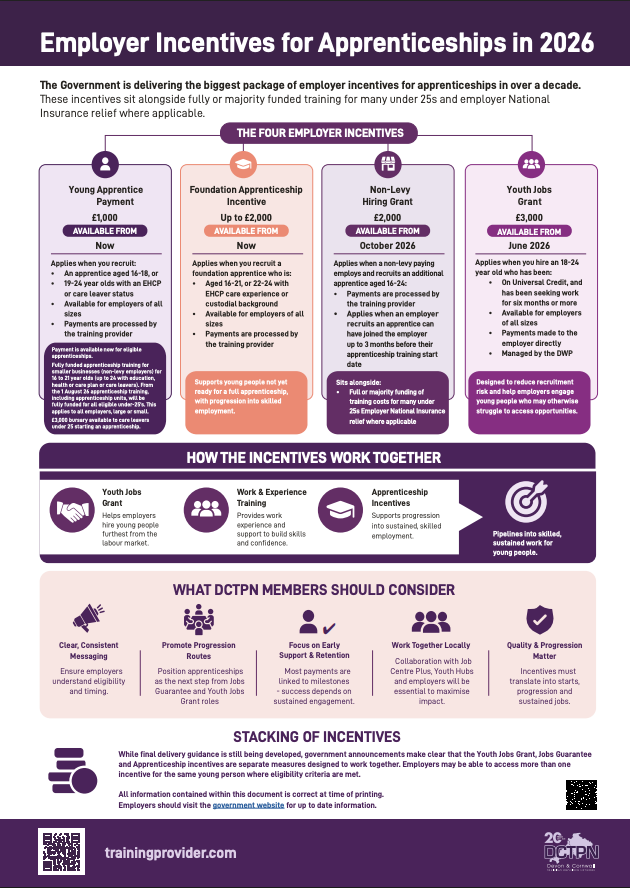

The Government is delivering the biggest package of employer incentives for apprenticeships in over a decade. See our latest resource for employers, which outlines the financial and practical incentives available to support you in taking on a young person or an apprentice.
As an employer, you can benefit from the flexible wage structure for apprentices. While the minimum wage rate for apprentices is set at a certain rate, many employers choose to offer higher pay.
Apprentices in their second year of study receive increased wages, with specific rates varying based on age groups (under 18 and over 21). Additionally, certain sectors, regions, and higher-level Apprenticeships offer competitive wages, sometimes up to £500 per week.
More details on salaries and entry criteria in specific Apprenticeship occupations can be found here.

To apply, click here. You will need to create a user account, then you can search and apply online using the relevant ‘search’ selections. At any one time, there are up to 28,000 Apprenticeship vacancies available online in a variety of careers and industries across England.
‘I got to work with experienced staff, take part in events, learn new things, and complete a qualification at the same time as having the best time.’

Available to individuals aged 16+ apprentices are typically employed for at least 30 hours per week.
All apprentices will earn a salary of at least the National Minimum Wage for apprentices.
Most apprenticeships take between 1 – 4 years to complete.
They start at levels equivalent to GCSEs right up to master’s level and degree level.
All costs are paid for by the employer and/or the government meaning that an apprentice will never have to pay.
The equivalent of 6 hours per week of an apprentice’s paid time will be spent off-the-job learning.
Most of an apprentice’s paid time will be spent on-the-job, working with colleagues to learn skills and gain experience.
New apprenticeships are advertised each week covering a wide range of job roles, thousands in more than 170 industries.

Yes! The Government is delivering the biggest package of employer incentives for apprenticeships in over a decade. See our latest resource for employers, which outlines the financial and practical incentives available to support you in taking on a young person or an apprentice.
You must pay the apprentice minimum wage. Your training costs could be partly covered depending on your business size and the age of the apprentice. You could receive a government contribution of up to 100%.
Calculate your estimated training cost funding.
You could receive additional payments of £1,000 for recruiting:
As an apprenticeship employer, you must provide:
Eligibility criteria for apprenticeships vary, but generally, individuals must be 16 or older and not in full-time education. Specific entry requirements may depend on the industry and level of the apprenticeship. While some apprenticeships may require certain qualifications, others may focus more on aptitude and enthusiasm for the chosen field.
The duration of apprenticeships can vary based on factors such as the level of the apprenticeship and the industry. Apprenticeships in the UK usually last between one to six years. Higher-level apprenticeships or those in specialized sectors may have longer durations. The time is divided between practical, on-the-job training and academic learning.
A Levels:
T Levels:
V Levels are exciting new qualifications, equivalent to existing Level 3 qualifications, & will allow young people to explore their career options by enabling them to experience a specific sector such as IT, Early Years & finance. They will launch in September 2027.